
Risk management
This report is presented by the Company's Risk and Sustainability Committee (Committee). Due to the constant evolution of the environment in which the Group operates, Adcock Ingram appreciates that success rests on the ability to capitalise on opportunities and pro-actively manage risk.
COMPOSITION AND MEETINGS
The Committee consists of six (6) directors; four are non-executive directors (three of whom are independent) and two executive directors. Four (4) scheduled meetings are held per year and the Head of Internal Audit, the Medical Director as well as a Risk Advisor from Marsh are permanent invitees.
The attendance of the Committee meetings was as follows:
| Meeting attendance | ||
| Chairman | ||
| R Stewart | 4/4 | |
| Members | ||
| A Hall | 4/4 | |
| M Haus | 4/4 | |
| J John | 3/4 | |
| C Manning | 4/4 | |
| D Neethling | 4/4 | |
| M Sacks* | 2/2 | |
| Invitees | ||
| J Bhana (Medical Director) | 3/3 | |
| D Nabarro (Risk advisor - Marsh Risk Consulting) | 4/4 | |
| S Pietropaolo (Head of Internal Audit) | 3/4 |
* See changes to the Board.
TERMS OF REFERENCE
The Committee operates in accordance with formal terms of reference and a work plan, which were reviewed and amended in line with King IV and approved by the Board.
ROLES AND RESPONSIBILITIES
THE BOARD
The Board is responsible for the Group's risk governance which is achieved through its oversight committee being the Risk and Sustainability Committee. Certain members of the Audit Committee are also members of the Risk and Sustainability Committee.
The Board is updated on key risks and considers their residual level when formulating strategy, approving budgets and monitoring progress against business plans. The Board ensures that an adequate level of assurance is provided on control processes related to significant risks.
RISK AND SUSTAINABILITY COMMITTEE
The roles and responsibilities of the Committee are governed by a formal Charter which is reviewed annually and approved by the Board. The following duties were assigned to it by the Board during the year under review:
- Ensure an appropriate and effective control environment and clear parameters within which risk is managed.
- Oversee issues relating to sustainability.
- Oversee the conducting of a business risk assessment to identify the most significant commercial, financial, compliance and sustainability risks and implement processes to mitigate these risks.
- Assist the Board in setting the risk strategy and policies in determining the Group's tolerance for risk.
PHILOSOPHY
Adcock Ingram recognises the inherent exposure, with regards to the broad range of risks the Group faces, in achieving sustainable growth. This has cultivated the philosophy to develop a culture which views Enterprise Risk Management as a strategic enabler and ensures proactive and appropriate action is taken in mitigating risk exposure and taking advantage of opportunities.
Adcock Ingram acknowledges that risk can never be totally eliminated but is committed to ensure that the implemented Enterprise Risk Management process aligns to current best practices. This is to ensure that risk and control processes are continuously evolving to improve decision making.
Processes have been designed and implemented to identify, assess, manage, monitor and report on the significant risks faced by each division individually and the Group as a whole, on a continual basis. The Group views this approach as core in terms of achieving the appropriate balance between risk and reward. This enables management to protect the Group against avoidable risks and develop mitigating controls related to unavoidable risks.
KEY ACTIVITIES
RISK GOVERNANCE
The Group's divisions have different product, market, operating and financial characteristics. The responsibility regarding the top-down Enterprise Risk Management process therefore, vests largely with divisional management structures, supported by the Head of Internal Audit.
Risk registers, containing key business risks, are compiled, reviewed and updated on at least a quarterly basis. Risks on these registers are classified based on severity and probability of the risk materialising. Controls are identified to mitigate the identified risks and to prioritise action plans according to the residual risk. Registers are presented and discussed at various management levels and forums before they are presented and discussed at the Risk and Sustainability Committee meetings, which in turn, reports to the Board.
OTHER GOVERNANCE
The Company Secretary is responsible, together with management, for the implementation and execution of effective compliance. During the year, the Committee considered reports provided by management that covered the following areas:
- Quarterly reports from the independently operated whistle-blowing facility called Tip-Offs Anonymous. This whistle-blowing facility is available 24 hours per day, 365 days per year. All complaints lodged through this service are investigated and where appropriate disciplinary action is instituted. Where weak controls are identified, appropriate improvements are introduced to remedy the identified weaknesses;
- Quarterly regulatory risk reports, which highlight changes in the medical regulatory environment which might have an impact on the business; and
- Quarterly reports from the Risk Advisor which include details regarding insurable risks as well as health and safety, and environmental risks.
INFORMATION AND TECHNOLOGY (IT) GOVERNANCE
Adcock Ingram concurs with the King IV Report that technology and information should be governed in a way that supports the Company's setting and achievement of its strategic objectives. The Board through this Committee, is responsible for the governance of technology and information but the implementation and execution of effective technology and information management is delegated to management.
The Head of IT presents to the Committee how the related risk is assessed and managed within the Company.
Information Technology is an integral part of the operations as an enabler and the Group has implemented a number of arrangements governing and managing technology and information, including but not limited to:
- an IT strategy that underpins the business strategy;
- an IT Governance framework to ensure relevant processes and structures are in place that meet the business requirement;
- implementing relevant IT best practises;
- implementing a validation policy in terms of which technology and systems implementation are validated according to the Good Manufacturing Practices (GMP) and Pharmaceutical Inspection Co-operation Scheme (PICS) principles that also covers requirements from other pharmaceutical companies that makes use of the Adcock Ingram facilities;
- Internal Audit performs audits on different parts of the Company to test the effectiveness of internal controls;
- Group Quality Assurance audits incorporate industry's best practices to ensure constant and continuous improvement of Adcock Ingram's quality systems, processes, technologies, infrastructure, regulatory compliance and technical support; and
- audit procedures conducted by the External Auditors in support of their audit opinion.
Key areas of focus during the reporting period were as follows:
- The IT policy was reviewed to align to the requirements of the King IV;
- Application systems enhancements and expansions;
- Infrastructure upgrades were undertaken;
- Cyber security was upgraded. Adcock Ingram uses a multi layered IT security framework to detect and prevent, as far as possible, cyber security attacks. The IT security environment is in a continuous process of improvement to address potential issues identified through a variety of audits, attack and penetration testing, and the latest IT security guidelines; and
- Phase 1 of the new Quality Assurance system and Transportation management systems went live.
Key areas of focus in the future include:
- Integration of the IT environments of recently acquired businesses (Virtual Logistics and Genop);
- The optimisation of the forecasting and planning systems, as well as the implemented process manufacturing systems, forms part of an operational continuous improvement process;
- Further enhancements to the IT security environment;
- Ensuring POPIA readiness; and
- Implementation of a new laboratory information management system, a new pharmacovigilance system, digitisation of business processes and finalising the last phase of the new quality assurance system.
ENTERPRISE RISK MANAGEMENT
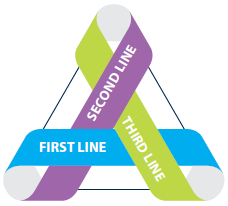
The diagram below depicts Adcock Ingram's model for risk management
THREE LINES OF DEFENCE
The Group manages risk by employing the three lines of defence strategy. This demonstrates how the Board ensures that risk is treated as integral to the way it makes decisions and executes its duties and promotes transparency and accountability.
FIRST: DIVISIONAL |
SECOND: EXECUTIVE MANAGEMENT |
THIRD: INDEPENDENT ASSURANCE PROVIDERS |
|||||
|
|
|
The independent assurance providers were recently reviewed. The Committee is satisfied they objectively provide assurance regarding the activities of the first and second lines of defence. |
|
KEY RISKS | CONTROLS IN PLACE TO MITIGATE THE RISKS | ||||||
| Market share | ||||||||
| The actions of our competitors may erode our market share and potentially jeopardise our growth. | The autonomous business units through robust sales and marketing efforts, customer relationship management and customer service delivery, assist the Company in combatting competitor actions. | |||||||
| Foreign exchange | ||||||||
| The uncontrollable currency volatility and Rand weakness impacts the purchase price of active pharmaceutical ingredients (API's), specialised machinery and finished goods sourced internationally, in turn putting margins under pressure. | Forward cover is taken out for all firm import orders. | |||||||
| Supply and cost pressure | ||||||||
| There are a limited number of suppliers of API's and finished goods, and many of these supplies are acquired in a foreign-denominated currency. | Where available, multiple suppliers of API's and finished goods are sourced. Safe levels of stockholding of strategic raw materials and finished goods are maintained. | |||||||
| Cost-push versus pricing power | ||||||||
| SEP increases generally do not keep pace with the level of cost-push. | Various continuous improvement programmes and procurement initiatives are in place to improve throughput and efficiencies throughout the Group. | |||||||
STRATEGIC PILLAR IMPACTED
|
Economic environment | |||||||
| Economic data indicates very little, if any, growth in the South African economy resulting in the trading environment remaining difficult with the potential for further deterioration. | The Group has a well-diversified product portfolio which trades across many price-points and therapeutic categories. New geographies, through exports and distributorships, are continually being sought. | |||||||


|
KEY RISKS | CONTROLS IN PLACE TO MITIGATE THE RISKS | ||||||
| Human Capital | ||||||||
| Critical skills shortages and difficulty in recruiting top talent in certain areas of the business, are a reality in the current economic environment. The need to attract and retain top talent, is intensified by our transformation strategy. | Appropriate incentive schemes, competitive remuneration packages and investment in skills development of employees are used to provide a sustainable pipeline of talent for the future. | |||||||
| Labour environment | ||||||||
| Trade unions represent a significant number of employees. Labour disputes and work stoppages may disrupt business operations. | Contingency plans are in place at all sites to ensure continuity of supply. | |||||||
STRATEGIC PILLAR IMPACTED Transformation |
Occupational health and safety | |||||||
| Occupational injury of employees who are key to the performance of the Group may occur. | Stringent policies and procedures, aligned to best practice, as well as robust training and awareness programs have resulted in the continuous improvement of safety practices in the work place. | |||||||

|
KEY RISKS | CONTROLS IN PLACE TO MITIGATE THE RISKS | ||||||
| Customer, supplier and partner relationships | ||||||||
| Customers are the cornerstone of our business. Our customer relationship management has been, and continues to be a key focus area. | Management of the expectations of our business partners is an ongoing focus for our autonomous Divisions. The relationship foundations created are continuously nurtured to ensure sustainable business growth. | |||||||
STRATEGIC PILLAR IMPACTED
|
Schedule 0 (S0) SEP exemption | |||||||
| The exemption for S0 medicines with regards to the SEP legislation is reviewed by the regulatory authorities on a periodic basis, currently every three years. Removal of this exemption could place further pressure on margins. | Management utilises the three-year excemption granted during 2016. This allows S0 products to be subject to "free-pricing" strategies. | |||||||

|
KEY RISKS | CONTROLS IN PLACE TO MITIGATE THE RISKS | ||||||
| Regulatory | ||||||||
| The complex and ever-evolving regulatory environment in which the Group operates, provides challenges which are common throughout the pharmaceutical industry. | Through continuous monitoring, a rigid approach to quality control and assurance, and a prudent business approach, compliance is continuously achieved through the ongoing combined efforts of various operational and technical teams. | |||||||
| Information technology infrastructure upgrades | ||||||||
STRATEGIC PILLAR IMPACTED
|
Adequacy and effectiveness of IT governance, and integration of IT systems. | Through the use of best practice project management methodology as well as highly skilled human resources, implementation of new and improved information technology infrastructure is successfully achieved. The Committee reviewed its investment in regulatory capacity and capability, which it considers to be a significant strength of the Group. | ||||||

|
KEY RISKS | CONTROLS IN PLACE TO MITIGATE THE RISKS | |||||||
STRATEGIC PILLAR IMPACTED
|
Interruptions of supply by utility providers | ||||||||
| The interruption of supply of water and electricity poses the threat of suspending production and compromising order infill rates. | Back-up power supplies as well as on-site water storage facilities and boreholes allow for continuous production during periods of interruption. All manufacturing sites in South Africa have been declared National Key Points. | ||||||||

|
KEY RISKS | CONTROLS IN PLACE TO MITIGATE THE RISKS | ||||||
| Product portfolio | ||||||||
STRATEGIC PILLAR IMPACTED
|
Components of the portfolio consists of relatively old molecules. | Continuously seeking opportunities with regards to less regulated products as well as entering into partnerships with multinational principals to broaden the product portfolio. | ||||||
| Plant mechanisation | ||||||||
| Stock levels and order infill rates may be put under strain in the event of a critical plant breakdown. | Robust maintenance plans, where possible dual site manufacturing, as well as mechanisation upgrades mitigate this risk. | |||||||
