
Human capital
"The following ingredients are non-negotiable for sustainable business growth: quality, positive attitude, a diverse workforce, an entrepreneurial mindset, effective and efficient processes, collegial culture and fun in the workplace" – Executive Director Human Capital and Transformation – Basadi Letsoalo.
OUTCOMES
WORKFORCE PROFILE OF EMPLOYEES IN SOUTH AFRICA
| 2018 | 2017 | |||
| Number of Permanent Employees: | ||||
| Gender Split | 2 610 | 2 218 | ||
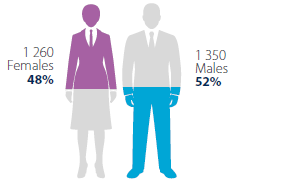
| Male | 1 350 | 1 085 | ||
| Female | 1 260 | 1 133 | ||
| Racial Split | ||||
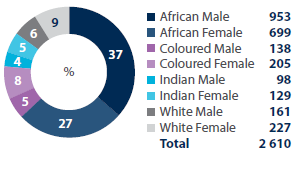
| African | 1 652 | 1 411 | ||
| White | 388 | 312 | ||
| Indian | 227 | 167 | ||
| Coloured | 343 | 328 | ||
| Racial and Gender Split | ||||
| Black male | 1 189 | 965 | ||
| White male | 161 | 120 | ||
| Black female | 1 033 | 941 | ||
| White female | 227 | 192 |
EMPLOYEE CATEGORIES
| 2018* | 2017 | |||
| Permanent Employees | 2 610 | 2 218 | ||
|---|---|---|---|---|
| Total Remuneration package | 1 339 | 1 138 | ||
| Bargaining unit | 1 271 | 1 080 | ||
| Contract/Temporary Employees | 258 | 147 |
* Includes AVL and Genop
HEALTH AND SAFETY
No fatalities (injuries on duty resulting in death) occurred during the current and prior year. Lost time injuries (injuries on duty leading to at least one lost day) decreased to 16 (2017: 20), a reduction of 20%. Details below:
| 2018 No of injuries |
2018 LTIFR |
2017 No of injuries |
2017 LTIFR |
|||||
| Aeroton | 7 | 1.44 | 13 | 1.55 | ||||
|---|---|---|---|---|---|---|---|---|
| Wadeville | 1 | 0.05 | 2 | 0.15 | ||||
| Clayville | 3 | 0.56 | 4 | 1.30 | ||||
| Midrand | 2 | 0.47 | 1 | 0.16 | ||||
| Distribution | 3 | 0.72 | 0 | 0.00 | ||||
| Total | 16 | 0.49 | 20 | 0.40 |
LTIFR = lost time injury frequency rate
There were 59 medical cases (2017: 73), a reduction of 19.2%, and 282 first aid cases (2017: 273), an increase of 3.3%.
Management's areas of focus for the current year was to increase health and safety training and create awareness at the various sites to address health and safety in general.
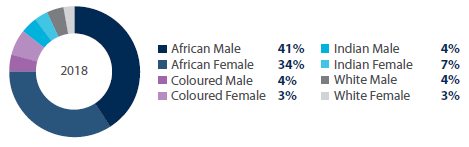
GENDER DISTRIBUTION |
RACE DISTRIBUTION |
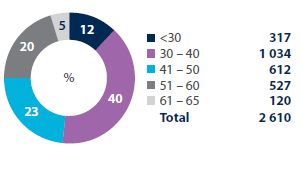
AGE DISTRIBUTION |
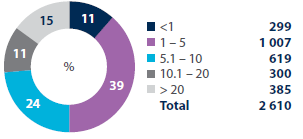
YEARS OF SERVICE |
|||
 |
 |
 |
 |
LEARNING AND DEVELOPMENT TO RETAIN SKILLS
A successful business is dependent on a skilled workforce. Good skills ensure effective and efficient manufacturing and delivery of our products and services. Employees who develop their skills are able to advance more quickly through the organisation and are also more likely to stay with Adcock Ingram.
Various training opportunities are offered to employees ranging from basic literacy and numeracy, to computer-based training, management and leadership programmes.
A key challenge in developing employees is balancing the business operational needs with the training ambitions of the employee.
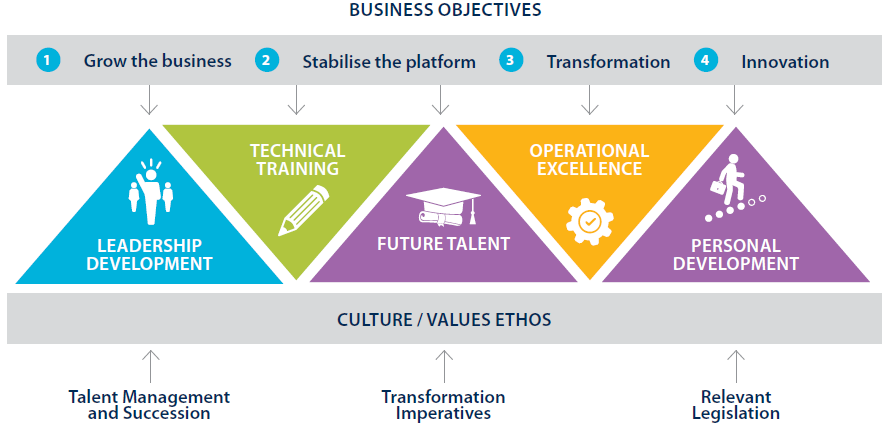
The framework for learning and development is depicted below:
GROWING THE BUSINESS BY GROWING PEOPLE
BENEFICIARIES OF TRAINING INTERVENTIONS
Skills development is critical to ensure that we have the right people capability to deliver the Group's strategy. This is not only limited to our employees but also to the unemployed talent pipeline. The unemployed talent pipeline includes the combination of all previously unemployed people that the Company employs on a fixed-term contract and includes apprentices, learners with disabilities, graduates and pharmacy interns.
Developing a talent pipeline to support business growth and transformation is one of the key objectives of learning and development. Adcock Ingram continues to increase training spend in South Africa year-on-year, having spent R33 million in 2018, compared to R23 million in 2017 and R18 million in 2016.
 FUTURE TALENT |
 TECHNICAL TRAINING |
 LEADERSHIP DEVELOPMENT |
 OPERATIONAL EXCELLENCE |
 PERSONAL DEVELOPMENT |
||||
| To provide a pool of talent for the business, focussing on critical skills | To enhance technical skills of our employees and process efficiencies | To enhance and expand capacity of leaders for execution of the Group Strategy | To increase technical expertise of our employees and their overall performance | To assist employees with their development, career aspirations and enhancing competencies | ||||
| 18 graduate workplace experiences | 24 basic pharmacy assistants | 48 supervisor development programmes | 66 project management | 29 study assistance | ||||
| 14 pharmacy interns | 26 post basic pharmacy assistants | 16 management advancement programmes | 16 supply chain management | 36 adult basic education and training | ||||
| 15 apprenticeships | ||||||||
| 34 national skills fund workplace experiences | ||||||||
| 22 learnerships for people living with disabilities |
PROMOTING EMPLOYEE HEALTH AND WELLNESS
Promoting health and wellness has a positive influence on our employees' wellbeing and productivity, at work and outside.
Adcock Ingram offers an Employee Assistance Programme (EAP) in conjunction with ICAS that is open to all permanent and contract employees, providing professional and confidential counselling services, designed to assist with personal distress that may or may not impact on productivity or work performance. These anxieties include, but are not limited to, health, including mental health, relationships and family, financial and legal, alcohol and substance abuse, grief and bereavement, trauma and critical incidents. Stress and relationships issues are the two most prominent concerns listed.
The overall engagement rate*, which includes uptake of all services provided by ICAS, amounted to 27.8% during the year under review, compared to 30.4% during 2017 but is still above the ICAS average of 19.1%. Plans are in place to promote these services continually to all employees.
* Engagement rate is made up of individual cases, group interventions participants, and profiled eCare users who are internet users who ask questions and access content.
HEALTH AND SAFETY
Adcock Ingram has onsite clinics with qualified health practitioners at our three factories as well as in Midrand. The onsite clinic's focus is meant to be 70% towards occupational healthcare and 30% towards primary healthcare, however the current situation indicates that the clinics are being used for a significantly higher amount of primary healthcare purposes in comparison to occupational healthcare issues.
- Primary healthcare includes: respiratory, cardiovascular, digestive, UTI, skin, wellness, hypertension, diabetes, asthma, epilepsy, tuberculosis, and HIV
- Occupational healthcare includes: periodic assessments (pre-employment, post-employment and exit), vision screening, first aid, disability and injuries on duty.
TRANSFORMATION, DIVERSITY AND INCLUSIVITY
Adcock Ingram is committed to uphold human rights, which includes ensuring that all employees and people we deal with are treated with dignity and respect. We value diversity and inclusion and are committed to non-sexism and non-racism across our policies, practices and daily operations. This journey is underpinned by our Company values and solid transformation strategy to ensure the sustainability of our efforts and impact thereof.
PROGRESS ON BROAD-BASED BLACK ECONOMIC EMPOWERMENT ACT
Compliance with the Broad-Based Black Economic Empowerment Act (B-BBEE Act) ensures that we contribute meaningfully towards national priorities to transform the industries in which we operate, to make the economy more inclusive. Under the guidance of the Social, Ethics and Transformation Committee (SET) we have continued to improve on our implementation plan for a sustainable contribution to the transformation agenda. As such the B-BBEE status as independently assessed by Empowerlogic in November 2017 resulted in a Level 3 rating.
EMPLOYMENT EQUITY
Employment Equity is a national imperative, legislated through the Employment Equity Act. Compliance requires that we put in place systems to enable a diversified and equitable workplace that continues to reflect national priorities. There has been extensive work done to ensure integrated and sustainable Employment Equity Act compliance, and consultation takes place across the business via the National Transformation Forum and site forums in all our divisions.
TALENT MANAGEMENT
As a forward-looking organisation, Human Capital is considered integral and a key ingredient to Adcock's Ingram success. By ensuring that we have the best people in the right roles and a healthy environment, we empower our people to create better futures for themselves and the business. To this end we value individual and collective performance.
Key to the sustainability and future of our business is managing the succession pipeline, in particular, of senior and executive management. Our aim is to ensure a 2:1 succession cover ratio of the leadership level where possible, meaning that each leader has at least two potential successors, one who can fill the position within a short timeframe and the second in the medium- to long-term.
"Growing our own timber" is our business mantra. Employees are encouraged to develop their capabilities in line with the business growth plan. In the absence of skills within the talent bank, this expertise is acquired externally.
EMPLOYEE RELATIONS
We are committed to a workplace free from discrimination, compliant with all the relevant labour laws, and are resolute on transparency and open communication. This ensures that workplace grievances are avoided or speedily resolved. The Company has maintained a low referral rate to the CCMA and Bargaining Council.
The Heads of Human Capital from the respective sites engage with the unions regarding various bargaining unit employee related matters as well as wage negotiations. This year a two-year wage agreement was concluded between the Group and the union, effectively agreeing on the increases for 1 July 2017 as well as 1 July 2018.
41% of employees in South Africa belong to a bargaining unit, with the union membership split as follows:
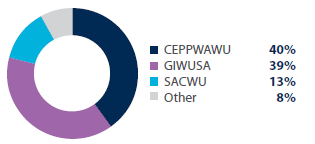
During the year, Giwusa members undertook industrial action regarding a revised disciplinary procedure. The 10-day strike was resolved through a constructive mediation process. The strike was confined to the Clayville site and business contingency plans were in place to minimise the disruption of operations. Regrettably 2 989 man days were lost due to this industrial action.
THE YEAR IN REVIEW
Highlights
- Improvement in the:
- Disability profile; and
- Number and gender diversity of participants in the owner-driver scheme.
- Increase in skills development spend.
- 100% absorption of talent pipeline including apprentices, disabled learners and graduates.
- Achieved B-BBEE Level 3 rating.
- A 2-year wage agreement negotiated with the Bargaining Council.
- A decrease in staff turnover from 10.4% to 10.1% against an industry norm of 11.2%.