REALISING CAPITAL OUTCOMES
Natural capital
Natural capital
The protection of the environment is a key consideration when acting as a responsible corporate citizen. As a manufacturer of pharmaceutical products, the regular above inflation increases of energy and other utility costs, have a major impact on Adcock Ingram. Throughout our operations, the focus remains on providing quality products and a safe and healthy workplace for employees, whilst minimising the potential impact on the environment.
With increased production an increase in the usage of utilities is inevitable. The Group’s carbon footprint in South Africa will also increase as the Group realises its strategy of acquiring local businesses, which leads to an increase in headcount, manufacturing output and distribution activities.
The Group’s carbon footprint in South Africa determined by “Carbon Calculated” is as follows and includes AVL Healthcare for the full year (2017: 3 months) and Genop for six months.
| 30 June 2018 Tonnes |
30 June 2017 Tonnes |
||||
| Scope 1 | |||||
| 1 | Equipment owned or controlled | 13 613 | 11 093 | ||
|---|---|---|---|---|---|
| Air conditioning and refrigeration gas refills | 397 | 506 | |||
| Vehicle fleet | 2 517 | 2 618 | |||
| Scope 1 total | 16 527 | 14 217 | |||
| Scope 2 | |||||
| 2 | Electricity | 47 860 | 48 467 | ||
| Total scope 1 and 2 | 64 387 | 62 684 | |||
| Scope 3 | |||||
| 3 | Business travel | 2 520 | 1 351 | ||
| 4 | Employee commute | 4 776 | 4 059 | ||
| 5 | Transportation and distribution of raw materials and | 21 594 | 13 760 | ||
| sold goods | |||||
| 6 | Packaging materials | 9 972 | 15 693 | ||
| 7 | Consumption of office paper | 284 | 86 | ||
| 8 | Total waste (landfill and recycled) | 3 948 | 2 898 | ||
| 9 | Water and wastewater | 405 | 454 | ||
| Electricity transmission & distribution losses | 4 341 | 4 261 | |||
| Total scope 3 | 47 840 | 42 562 | |||
| Total scope 1, 2 and 3 | 112 227 | 105 246 | |||
| Non-Kyoto gas | 1 006 | 2 031 | |||
| Grand total | 113 233 | 107 277 |
1 Aeroton increased its coal usage by 16% consequent an increase in output.
2 The emission factor** decreased between the reporting periods so the relative carbon decrease more than offset the kWh increase from AVL Healthcare and Genop.
3 Increase in flights with the addition of headcount and the on-boarding of Genop.
4 Employee commute increased as a result of increased employee numbers with the acquisition of Genop.
5 The increase relates to the inclusion of the AVL logistics business and the expansion of the owner-driver scheme, adding additional smaller vehicles to the fleet.
6 Through improved reporting measures from Adcock Ingram’s suppliers, a more accurate impact for packaging material has been calculated.
7 The increase relates to the inclusion of Genop which prints its marketing brochures on high-end quality paper, which has a high emission factor.
8 The manufacturing facilities had an increase in waste through product write-offs.
9 A reduction in waste water was observed at Clayville following the installation of a borehole to supplement the municipal water supply.
| ** | An emissions factor is a representative value that attempts to relate the quantity of a pollutant released to the atmosphere with an activity associated with the release of that pollutant. Such factors facilitate estimation of emissions from various sources of air pollution. |
Actions to improve these results
- Electricity savings projects have been implemented at all the manufacturing sites including extension of the LED project. Wadeville plans to convert geysers and external lights to solar power.
- As most of the manufacturing sites have access to boreholes for water, the utilisation of this resource will be optimised.
- Increased focus and control on inventory management to prevent stock write-offs.
- Progress to be made with regard to waste recycling.
Scope 2 emissions by facility in tCO2e
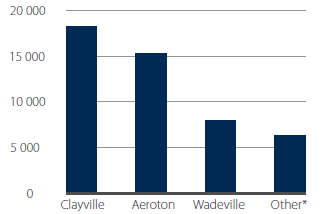
* Other includes all distribution facilities and administrative offices
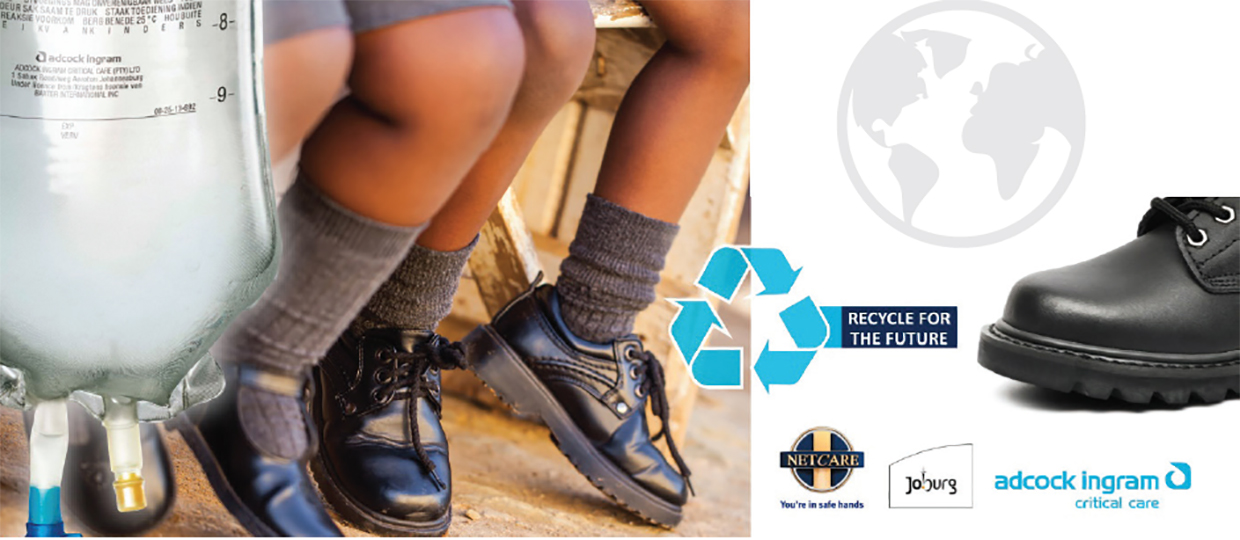
DRIVING SUSTAINABILIY AND ENTERPRISE DEVELOPMENT THROUGH PLASTICS RECYCLING
New joint venture with Netcare to make shoes from recycled drip bags for children
- A not-for-profit joint venture has been established to recycle drips and other PVC products
- This initiative will create employment and enterprise development opportunities in areas of PVC sorting, transportation, recycling and shoe manufacturing
- It is currently in operation at five Netcare hospitals
- To be rolled out across all hospitals
- The broader vision for the project is to include public sector facilities in the future
This will ultimately reduce landfill waste and improves environmental sustainability
To kick this project off, about 1 000 pairs of shoes were donated to learners of the Masakhane-Tswelopele Primary School in Zandspruit in January 2018.