Sustainability
This report is presented by the Company’s Social, Ethics and Transformation Committee (the Committee), appointed by the Board in respect of the year ended 30 June 2016.
COMPOSITION AND MEETINGS
The Committee consists of three non-executive directors, two of whom are independent, one executive director and the Human Capital Executive. Four Committee meetings were held during the year. The attendance of the Committee meetings was as follows:
| Committee member | Meeting attendance | ||
| PM Makwana (Chairman) | 4/4 | * | |
| AG Hall | 4/4 | ||
| T Lesoli | 4/4 | ||
| BJ Letsoalo | 4/4 | ||
| AT Mokgokong | 4/4 | ||
| KB Wakeford | 2/2 | * |
| *see changes to the Board |
ROLE AND FUNCTION OF THE COMMITTEE
The role and responsibilities of the Committee are governed by a formal Charter which is reviewed annually and approved by the Board. The following duties are assigned to it by the Board during the year under review:
| • | Monitor the Company’s activities regarding relevant legislation and codes of best practice; |
| • | Draw matters within its mandate to the attention of the Board; |
| • | Report to the shareholders at the Annual General Meeting; |
| • | Ensure Adcock Ingram’s equity ownership and the demographic profile of its employees is representative in the South African context; and |
| • | Establish, implement and monitor the framework for the Company’s transformation plan. |
PHILOSOPHY
We believe that each of our employees brings a unique set of skills, experience, perspectives and ideas that give Adcock Ingram the competitive edge.
We value this and reflect it in our Mission and Values: ‘We believe in the empowerment of our people, thus encouraging entrepreneurship, innovation and accountability’.
PEOPLE
The Group has identified the following human capital issues as being critical to the success of Adcock Ingram:
| • | Attracting and retaining the best skills; |
| • | Accelerating transformation and encouraging diversity; |
| • | Implementing succession management; |
| • | Providing learning and development, and career opportunities; and |
| • | Providing a safe work environment and employee wellness services. |
EMPLOYEE HEADCOUNT
| 2016 | 2015 | |||
| Permanent | 2 234 | 2 141 | ||
|---|---|---|---|---|
| Contractors / temporary | 171 | 233 | ||
| 2 405 | 2 374 |
Composition of permanent employees
| 2016 | 2015 | |||
| Male | 1 227 | 1 032 | ||
|---|---|---|---|---|
| Female | 1 007 | 1 109 | ||
| Black | 1 927 | 1 810 | ||
| White | 307 | 331 |
AGE PROFILE
Adcock Ingram’s workforce is well balanced by age. Young and upcoming talent (under 30 years of age) represents 16% of the workforce while the age group normally associated with greater career stability (between 30 and 50 years), represents 58%. The risk of losing intellectual capital and institutional experience is well managed, with only 26% of employees aged 50 and above.
WORKFORCE TURNOVER
Employee turnover for this year was 8.5% (2015: 9.7%).
LABOUR RELATIONS
In South Africa 49% of permanent employees are members of a recognised trade union. Adcock Ingram supports freedom of association and relevant agreements exist between the Company and various unions. The number of working days lost due to industrial action in 2016 was nil (2015: 1 633).
PEOPLE DEVELOPMENT
Learning and development
The development and growth of competent people is a key principle of Adcock Ingram’s Human Capital strategy. Team members are enriched by ensuring that they have the right skills, knowledge and competencies to reach their potential. Training programmes are designed to produce substantial benefits for both the Company and the employees.
During the year under review, our commitment to develop our employees, whilst aligning our strategy to the skills development (SD) element of the B-BBEE scorecard, continued.
TOTAL SPEND IN SOUTH AFRICA SPEND ON FEMALE EMPLOYEES 92% (2015: 90%) |
INVESTMENTS WERE MADE IN THE FOLLOWING CATEGORIES
|
SUCCESSION MANAGEMENT Succession management provides a framework to align leadership with the strategic needs of the business. It also provides ongoing job analysis and opportunity for key talent to adjust roles based on changing business conditions and strategic initiatives. To date the following succession benefits have been realised:
|
 |
EMPLOYEE WELLNESS
To be able to provide excellent service and achieve business goals, the emotional and psychological well-being of employees needs to be a prime goal. According to the Director of the Department of Public Health and Environment (WHO), ‘the wealth of business depends on the health of workers’. The Employee Assistance Programme is well suited to provide health counselling as well as resources/tools required to achieve an optimal state of well-being for employees. It is in this context that ICAS has been engaged to provide employee wellness programme services to Adcock Ingram as a partner in behavioural risk management.
HIV/AIDS PROGRAMME
Employees and their dependents, who are HIV positive, can enrol in the chronic disease management programme that is offered to employees through a service provider, Universal Care. This is open to all employees whether or not they are medical scheme members. Currently there are 23 participants on this voluntary support programme.
HEALTH AND SAFETY
Facilities
The annual risk control standards grading audits were conducted by Marsh (Pty) Ltd at all Adcock Ingram sites, excluding Ghana. In conducting these audits, the various sites were assessed in terms of preparedness and their performance with regard to risk control organisation, fire defence, security, emergency planning, occupational health and safety and motor fleet. The lowest and highest ratings were 97% and 99% respectively. Shortcomings were minor and were addressed.
The environmental risk control audit conducted by Marsh (Pty) Ltd assesses Adcock Ingram’s sites in regard to their performance in environmental leadership, environmental management implementation, operational management, monitoring and review and specific operations. This audit was conducted during the financial year at the manufacturing site in Bangalore, India, the Research and Development site at Aeroton and the distribution outlet in Cape Town. The lowest and highest ratings were 95% and 99% respectively.
Employees
There was a marked reduction in the number of lost time injuries, showing an improvement over the previous year.
Following are the statistics for the number of lost time injuries (injuries on duty leading to at least one lost day) for the year:
| Aeroton | Wadeville | Clayville | Midrand | Durban | Total | ||
| 2016 | 7 | 0 | 3 | 2 | 0 | 12 | |
| 2015 | 19 | 2 | 9 | 2 | 1 | 33 | |
| LTIFR 2016 | 0.80 | 0 | 0.56 | 0.26 | 0 | 0.20 | |
| LTIFR 2015 | 2.18 | 0.55 | 1.95 | 0.32 | 0.85 | 0.73 |
| LTIFR = lost time injury frequency rate |
No fatalities (injuries on duty resulting in death) occurred during the current or prior year. There were 81 medical cases (injury on duty leading to medical treatment without losing a day’s work) in the current year compared to 68 medical cases in the prior year.
ENVIRONMENT
As a responsible citizen and a healthcare company, the protection of the environment is a key consideration for Adcock Ingram which is committed to the sustainable management and conservation of the environment. Throughout its operations the Company focuses on providing a quality service that creates a safe and healthy workplace for employees while minimising the potential impact on the environment.
Key areas of focus are:
| • | water management; |
| • | electricity consumption; |
| • | carbon emissions; and |
| • | stakeholder education and awareness. |
Increased factory throughput automatically results in higher usage of water and electricity. Despite this, good progress has been made with the replacement of fluorescent lights with low energy lights in the manufacturing facilities; the installation of day/night sensors; the charging of forklifts outside peak demand times and the shutdown of chillers and cooling towers during weekends.
Progress was also made with the conservation of water, with the repair of leaks, ongoing recycling of water and increasing borehole utilisation. Careful production planning, with longer runs and therefore less need for‘Cleaning in Place’, has also made a significant contribution to more efficient water usage.
CARBON FOOTPRINT
The carbon footprint results for South Africa determined by ‘Carbon Calculated’ are as follows:
| 2016 Tonnes |
2015 Tonnes |
|||
| Scope 1 | ||||
| Equipment owned or controlled | 12 045 | 12 442 | ||
|---|---|---|---|---|
| Air conditioning and refrigeration gas refills | 247 | 125 | ||
| Vehicle fleet | 2 220 | 2 404 | ||
| Scope 2 | ||||
| Electricity | 47 612 | 51 687 | ||
| Total Scope 1 and 2 | 62 124 | 66 658 | ||
| Scope 3 | ||||
| Business travel | 1 729 | 1 272 | ||
| Employee commute | 4 070 | 3 918 | ||
| Transportation & distribution of raw materials and sold goods | 17 751 | 16 893 | ||
| Packaging materials | 15 400 | 20 328 | ||
| Consumption of office paper | 44 | 68 | ||
| Total waste (landfill, recycled & effluent) | 3 902 | 3 337 | ||
| Water & wastewater | 525 | 581 | ||
| Total Scope 3 | 43 421 | 46 397 | ||
| Total Scope 1, 2 and 3 | 105 545 | 113 055 | ||
| Non-Kyotogas | 2 129 | 2 424 | ||
| Grand total | 107 674 | 115 479 |
DRUG MANAGEMENT AND DEVELOPMENT
Being a healthcare company, manufacturing medicines, the safety of quality and efficacious products supplied to our patients are of paramount importance. This is managed by the Drug Management and Development Team. This team comprises Research and Development, Quality Assurance, Medical Affairs and Compliance.
Research and Development
Adcock Ingram does not undertake or support any animal studies or test any of our products on animals. The Group uses accredited agents to carry out any bioequivalence studies required, usually known as Clinical Research Organisations (CRO’s). The policies which these appointed CRO’s have in place to govern their studies are aligned to local and international clinical research guidelines, such as those of the local Medicines Control Council (MCC) and the International Conference on Harmonisation of Technical Requirements for Registration of Pharmaceuticals for Human Use (ICH-guidelines).
Quality Assurance
Quality Assurance (QA) applies quality tools to monitor and control processes to assist in continuous improvement of our products. QA mitigates product quality risks through evaluations of customer complaints, product manufacturing changes and supplier changes.
Medical Affairs
Our pharmacovigilance system matches international standards to ensure the safety of our medicines and that of the patients who use them.
Pharmacovigilance, the ongoing surveillance of medicines safety data and the appropriate response thereto, is a requirement for any pharmaceutical company. Guided by the regulations of the MCC, Adcock Ingram has a robust system in place to detect, assess and manage adverse drug reactions to the medicines we market.
The MCC requires each company to have appropriate pharmacovigilance systems in place that will provide for the proper management of safety data for its medicines and to ensure that appropriate action can be taken when necessary.
Reports of adverse reactions, however minor they might seem, are actively collected from various stakeholders including customers and healthcare professionals. The Group’s systems are set up for ease of collection of relevant reports, recording and evaluation thereof and the reporting to the MCC, as required.
Compliance
The Compliance Department ensures that all promotional material and product packaging is legally compliant with the relevant statutory laws, regulations, rules and standards.
WHISTLE-BLOWING FACILITY
In pursuit of maintaining a commercially sustainable and ethical environment, free of criminal behavior, Adcock Ingram has a whistle-blowing facility to encourage employees and other stakeholders to report any suspected misdemeanor, anonymously. Inappropriate, unethical or illegal activity can be reported through the independently operated service, 24 hours per day and 365 days per year. The service is promoted extensively through internal communication tools.
Increased efforts during the year to promote the availability of the whistle-blowing facility resulted in a significant increase in the amount of reports.
All complaints lodged through this service are investigated, appropriate disciplinary action instituted if necessary and then reported to the Board through the Social, Ethics and Transformation Committee. During the year 40 reports were lodged of which 75% related to human capital issues and the balance to dishonest conduct. After investigation, 65% of the reports were dismissed as unfounded.
TRANSFORMATION
‘The success of our transformation approach is not defined by the numbers, but rather by the spirit in which we embrace this key strategic business imperative’
Our contribution to transformation is measured against the following:
| • | Department of Trade and Industry’s Codes of Good Practice (dti Codes) |
| • | A five year Employment Equity plan |
| • | Workplace skills plan |
ENTERPRISE DEVELOPMENT
The successful owner-driver initiative, was developed as an innovative scheme to give promising candidates ownership of a business, while realising the Company’s enterprise development objectives and maintaining customer service levels. During 2016 the fleet expanded with the addition of eight vehicles, bringing the fleet to 52 vehicles. Having commenced in 2012, this project has proved extremely successful with a total of 19 owner driver entrepreneurs now contracted to Adcock Ingram’s distribution service. The Company empowers the drivers through training in various standard operating procedures and shares with them new logistics technologies and business management skills.
In the words of Meshack Matswi, one of the first-phase and now established owner drivers, is the story of the impact made by the scheme on the lives of those involved: ‘I am fortunate that my business success has enabled me to build a three bedroomed home and has given my family the financial security that allows us to live happily and without stress. I have grown so much since being given this opportunity and have gained business skills that I use in running my business and which empower me to assist the newer owner drivers in the development of their enterprises. It is most fulfilling and the support I have gained from management has been excellent.’
The benefits of the scheme have been enjoyed by the Company, the drivers and the customers. The strategy is to build on the existing fleet as well as adding additional owner driver companies to the scheme.
PREFERENTIAL PROCUREMENT
As part of Adcock Ingram’s transformation journey, priority attention was given to procuring services from qualifying enterprises. This resulted in an 58% achievement of the target in the year ended 30 June 2016. R2.0 billion of procurement expenditure was included as qualifying expenditure for rating purposes. 26% of qualifying expenditure was placed with black-owned business and black women-owned enterprises. In order to increase procurement opportunities for Adcock Ingram’s small suppliers through collaboration and partnership, growing knowledge of the quality of services provided to Adcock Ingram by qualifying small enterprises and exempt micro enterprises, has allowed the procurement department to source from black owned recruitment agencies, suppliers of point of sale materials, packaging designers and print services.
SOCIO-ECONOMIC DEVELOPMENT
In line with Adcock Ingram’s commitment to be involved with the communities in which the Company operates and to undertake sustainable initiatives, there was a continued commitment to support a number of worthy causes during the year.
This support was focused largely on worthy causes which included:
| • | The continuing support for the Smile Foundation which coordinated a week of surgical interventions at the Tygerberg Hospital, and gave 43 children the opportunity to have life changing surgery to repair facial deformities; |
| • | Ongoing support for the Leratong Hospital in Krugersdorp, in the refurbishment of certain wards through the South African Medical and Education (SAME) Foundation; |
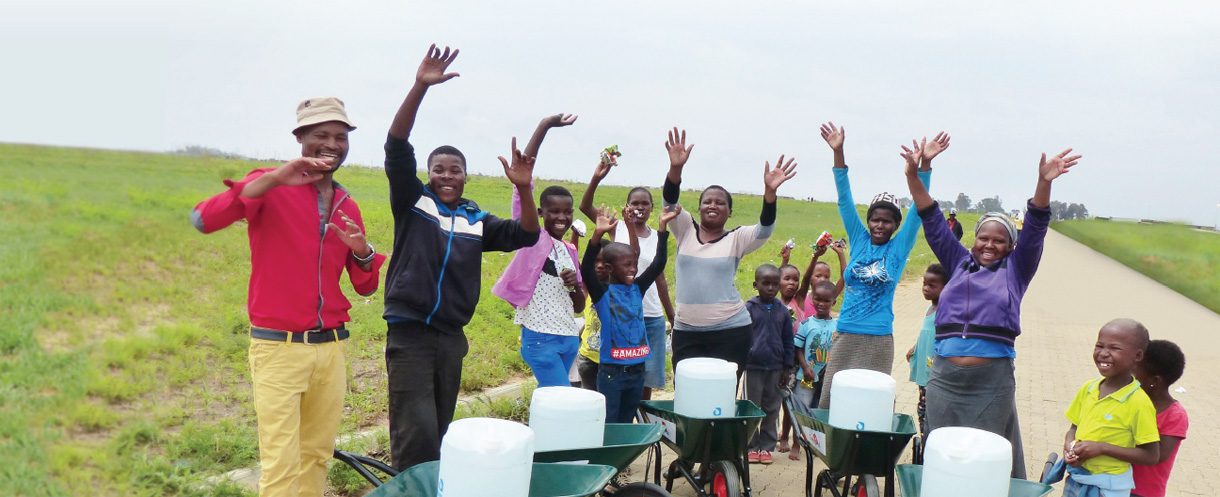
| • | Distribution of containers of water to drought stricken areas of the country was one of the most gratifying initiatives; |
| • | Mercy Vision (Ships), the Zithulele Eye Care Project, as well as Azali Healthcare, which funds medical male circumcision. |
Adcock Ingram contributed a total amount of R3.5 million during the year to improve the well-being of society. The focus of the support given was largely on healthcare, with smaller contributions to support orphaned and abandoned children.
Adcock Ingram’s CSI projects are an effort to build sustainable relationships, particularly with previously disadvantaged communities, in line with the Company’s proud heritage and mission: ‘To contribute meaningfully to the health and well-being of the people in the markets we serve’ and in support of the commitment of ‘Adding value to life’.