


Corporate governance
ETHICAL FOUNDATION
Ethics are the foundation of Adcock Ingram’s business and an unequivocal
commitment to fairness, transparency and integrity inspire all facets of
the Group’s operations. Adcock Ingram’s Board, assisted by its various
committees, is responsible for setting the ethical tone “at the top” and
monitors its implementation, to help ensure that business is conducted in
a manner that is beyond reproach at all levels in the Group.
The King III Report provides guidance on acceptable business practices and ethical standards by which Adcock Ingram directors, employees, suppliers and business partners are expected to conduct themselves in their business relationships.
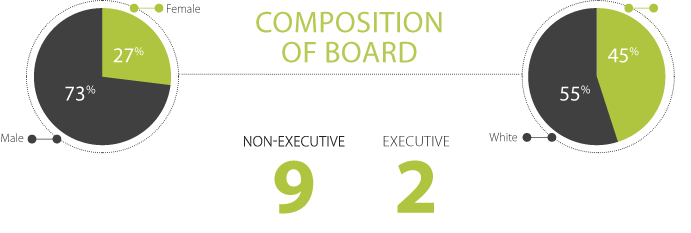
Corporate governance includes the structures, processes and practices that the Board uses to direct and manage the operations of the Adcock Ingram Holdings Limited and its subsidiaries within the Group to ensure that authority is exercised and decisions taken within a defined framework, approved by the Board, and decision makers are held appropriately accountable. The Company is committed to adhering to good corporate governance. A register setting out compliance with King III principles on an “apply or explain” basis can be found on www.adcock.com. The Board is the custodian of corporate governance and ensures that the Adcock Ingram Group adheres to the highest standards of accountability and ethical conduct. Employees are encouraged to report any suspected inappropriate, unethical, illegal activity or misconduct through an independently operated Tip-Offs Anonymous line. This whistle-blowing facility is available 24 hours per day, 365 days per year. All complaints lodged through this service are investigated and where appropriate disciplinary action is instituted and reported to the Board through the Social, Ethics and Transformation Committee. |
Adcock Ingram is committed to:
| • | Achieving the highest standards of transparency, accountability and integrity in all aspects of its operations and in its dealings with stakeholders including the community at large; |
| • | Providing stakeholders and the investor community with clear, meaningful and timely information about Adcock Ingram’s operations and results; |
| • | Conducting its business on the basis of fair commercial and competitive practice; |
| • | Building business relationships with suppliers and customers who embrace and comply with ethical business practices and who comply with the laws of the jurisdictions where they operate; |
| • | Actively pursuing transformation and ensuring employment practices which are not unfairly discriminatory and which seek to maximise the potential of all its employees through training and skills development; and |
| • | Proactively accepting responsibility for and managing the sustainability and environmental issues associated with its business. |
RETIREMENT
| As required by the Company’s Memorandum of incorporation (Moi) and the Companies act, an annual general Meeting is held once every calendar year. in accordance with the Company’s Moi, at least one-third of the non-executive directors retires by rotation every year and, if eligible, may off er themselves for re-election by shareholders. Thus, each non-executive director is rotated at least once every three years in accordance with the Moi. retiring non-executive directors who off er themselves for re-election are evaluated by fellow directors before a recommendation on their re-election is made by the Board to shareholders. | There is no term or age limit imposed in respect of a director’s
appointment; however, tenure is informed by a regular, formal
evaluation of the suitability, contribution and independence of each of
the directors. The terms and conditions applicable to the appointment
of non-executive directors are contained in a letter of appointment
which, together with the Board Charter, form the basis of the director’s
appointment. The Nominations Committee plays an important role in the
identification and removal of underperforming or unsuitable directors.
Brief curricula vitae of each of the directors.  |
|
BOARD CHARTER
| The Board is governed in accordance with a Board
Charter which sets out, inter alia, the principles and
process in terms of which directors are appointed, and
the duties and responsibilities of the Board. our Charter
and Moi demonstrate that there is a clear balance of
power and authority at Board level. no one director
has unfettered powers. decisions, if not unanimous, are
taken by a simple majority with one vote per director.
The Chairman does not have a deciding vote. issues of
confl icts of interest are regulated and dealt with regularly
in terms of the Board Charter and the Companies act.
in order to ensure that issues of confl ict of interests are
properly managed and dealt with, the directors’ register
of interests is circulated at all the scheduled meetings
of the Board for directors to confi rm the accuracy of its
contents. The declaration of interest and anti-competitive
behaviour are standing items on the Board agenda. The
Board Charter complies with the principles of the King iii
report wherever appropriate. The meetings of the Board and its committees are scheduled annually in advance. in addition to regular consideration of the group’s operational and fi nancial performance at each of its meetings, the Board’s annual work plan aims to ensure that the Board deals with each of the matters reserved for its consideration during the course of its annual meetings. |
Board papers are provided to directors in a timely manner, in advance
of meetings, and directors are aff orded ample opportunity to study
the material presented and to request additional information from
management where necessary. All directors are aff orded the opportunity
to propose further matters for inclusion on the agenda of Board meetings. The Board is given unrestricted access to all Group information, records, documents and facilities through the offi ce of the Company Secretary. The Company Secretary is also the secretary to all committees of the Board and ensures that the committees operate within the limits of their respective mandates and in terms of an agreed annual work plan. There is a formal reporting procedure to enable the Board to stay abreast of the activities of each committee. In terms of the Board Charter, the directors may obtain independent professional advice, at the Group’s expense, should they deem it necessary for the proper execution of their directorial role. Directors are kept appropriately informed of key developments aff ecting the Group between Board meetings. Non-executive directors have full access to management and may meet separately with management, without the attendance of executive directors, where necessary. Arrangements for such meetings are facilitated through the offi ce of the Company Secretary. |
|
BOARD EDUCATION AND TRAINING
| Directors are encouraged to attend external director development and training programmes, at the cost of the Group to ensure their knowledge of governance remains relevant. | In addition, all newly appointed directors are provided with an induction file containing important legislation and the Group’s governance framework (including the Board committee governance structure, the Board Charter, terms of reference of all Board committees and key Company policies) and are also offered a tour to the Company’s facilities. In the year under review, the Company Secretary presented amendments to JSE Listings Requirements to the Board. | |
BOARD EVALUATION
| The Board conducted an evaluation of itself to assess its eff ectiveness. | The Board has considered the outcome of the evaluation and will be working on addressing the identifi ed adverse outcomes. | |
BOARD COMPOSITION AND ATTENDANCE
| Board | Special Board | Acquisitions | |||||||||||||||||||||||||||||||||||||||||||||||||||||||||||||||||||||||
| Composition | Seven independent non-executive directors Two non-independent non-executive directors Two executive directors |
Seven independent non-executive directors Two non-independent non-executive directors Two executive directors |
Three independent non-executive directors One non-independent non-executive director Two executive directors |
||||||||||||||||||||||||||||||||||||||||||||||||||||||||||||||||||||||
| Members and meeting attendance |
|
|
|
||||||||||||||||||||||||||||||||||||||||||||||||||||||||||||||||||||||
| Invitees |
|
||||||||||||||||||||||||||||||||||||||||||||||||||||||||||||||||||||||||
| Responsibilities | Ultimately responsible to shareholders for the performance of the Group. Broadly gives strategic direction to the Group, approves and regularly reviews business strategy, budgets and policies. Appoints the executive directors and ensures that power and authority delegated to management are clearly and comprehensively documented and regularly reviewed. Ensures that the governance framework and strategic direction of the Group remain appropriate and relevant. The Board retains control over the Group, monitors risk and oversees the implementation of approved strategies through a structured approach i.e. reporting and accountability. |
Monitor and strengthen the objectivity and credibility of the Company’s acquisition strategy and plans. Consider and make recommendations to the Board on major acquisition plans and terms applicable to these acquisitions. |
|||||||||||||||||||||||||||||||||||||||||||||||||||||||||||||||||||||||
| The number of Board constituted committee meetings, held during the year under review, and the attendance thereof appear on pages Our risk management, Sustainability, Remuneration report and Independent auditor's report to the shareholder. |
CHANGES TO DIRECTORS’ RESPONSIBILITIES AND STATUS
11 November 2015
Dr Brian Joffe resigned as Chairman and Mr Clifford Raphiri, who was the Lead Independent Director, was appointed Non-executive Chairman;
Dr Joffe was appointed Deputy Chairman;
Mr Kevin Wakeford resigned as Chief Executive Officer and Director and Mr Andrew Hall was appointed Chief Executive Officer;
Ms Dorette Neethling, was appointed Acting Chief Financial Officer; and
Mr Lindsay Ralphs resigned as a Non-executive Director and was replaced by Mr David Cleasby.
2 February 2016
Mr Clifford Raphiri, the Non-executive Chairman of the Board, relinquished his chairmanship of the HR, Remuneration and Nominations Committee, but remained a member of this Committee and Chairman of the Nominations Committee;
Mr Mpho Makwana relinquished his membership of the Risk and Sustainability Committee and assumed chairmanship of the HR, Remuneration and Nominations Committee;
Mr David Cleasby assumed membership of the Risk and Sustainability Committee; and
The Chief Financial Officer no longer serves as a member of the Social, Ethics and Transformation Committee.
23 February 2016
Ms Dorette Neethling was appointed as an Executive Director and Chief Financial Officer.
24 May 2016
The CEO and CFO were appointed as members of the Acquisitions Committee.
15 June 2016
Mr David Cleasby resigned as a Non-executive Director and a member of the Risk and Sustainability Committee.
INFORMATION TECHNOLOGY (IT)
| Adcock Ingram subscribes to the statement in the King III Report that IT governance can be considered as a framework that supports effective and efficient management of IT resources to facilitate the achievement of the Group’s strategic objectives. | Adcock Ingram has implemented a number of projects with a view to improve its business processes and continues to improve these processes to achieve compliance. The implemented processes include:
|
|||||||||||||
INTERNAL AUDIT
| The internal audit function forms an integral part of
the governance structure of the group and its key
responsibility is to evaluate the group’s governance
processes and associated controls, amongst others, as
set out in the King III report. in performing its functions, the internal audit function provides reasonable assurance to the Board, through the audit Committee, regarding the eff ectiveness of the group’s network of governance, risk management and internal control processes and systems. |
It is more than a year since, the Internal Audit function has been in-house and the responsibility to oversee, manage, inform and take accountability for the effective operation of this function lies with the Chief Financial Officer. The Internal Audit function operates within a formally defined charter and annual audit plan which are approved annually by the Audit Committee. Furthermore, there has been co-ordination and sharing of information between the Group’s External Auditor and the Internal Audit function. |
|
COMPANY SECRETARY
| Mr Ntando Simelane is the Company Secretary of the Group. All directors have unlimited access to the Company Secretary for advice to enable them to properly discharge their responsibilities and duties in the best interests of Adcock Ingram, with particular emphasis on supporting all the directors, including the Chairman. The Company Secretary works closely with the Chairman of the Board, Chairmen of the respective committees and executive directors, to ensure the proper and effective functioning of the Board and the integrity of the Board governance processes. | The Board can confirm that it has considered and satisfied itself with regard to the competence, qualifications and experience of the Company Secretary. In the year under review, the Company Secretary was evaluated by the directors. The evaluation criteria included the following areas:
The evaluation questionnaires were collated and analysed by independent advisors and the results thereof shared with the Board. Based on the results of the evaluation, the Board can confirm that the Company Secretary is competent and has relevant experience to discharge his duties. Furthermore, the Company Secretary is suitably qualified for this role, conducts his duties professionally, maintains an arm’s length relationship with the Board and is not a director. |
|||||||||